Who this is for
You lead a customer success or support team, or you run a book of accounts yourself, and your company lets you use an AI agent at work. You know your job. You just lose too much of the week to collecting facts: which accounts are slipping, what happened in that escalation, what you promised in last quarter's QBR.
Who it isn't for
It isn't software. It's a PDF of prompts and the judgment around them, so you still do the setup. It won't help if your company bans AI tools on customer data either. Several plays work on an export with the names taken out, but ask your IT or security team first.
The 14 AI agent routines for customer success
- Monday Churn-Risk DigestEvery Monday morning
- QBR First DraftBefore each quarterly review
- Escalation Brief for LeadershipWhen an escalation is open
- Renewal Brief at 90, 60 and 30 DaysDaily, speaks up when a renewal hits a milestone
- Sales to CS Handoff NoteWhen a deal closes
- 1:1 Prep for Each Direct ReportBefore each 1:1
- Voice of the Customer MonthlyFirst business day of the month
- Morning Inbox TriageEvery weekday morning
- Knowledge Base Gap FinderEvery Friday
- Friday Update to Your ManagerFriday afternoon
- New Customer Onboarding TrackerTwice a week
- Executive Sponsor Check-in DraftsFirst Monday of the month
- Customer Survey Follow-upEvery weekday
- Team Workload Balance CheckEvery Wednesday
What's inside
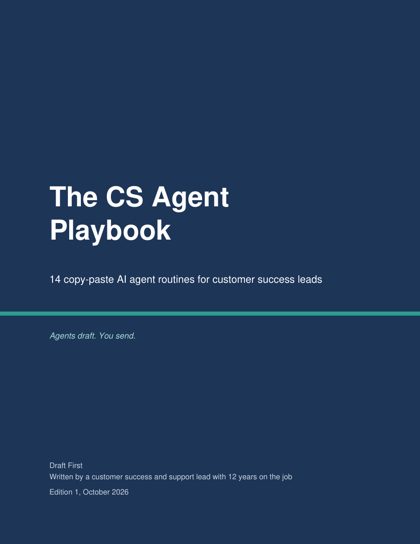
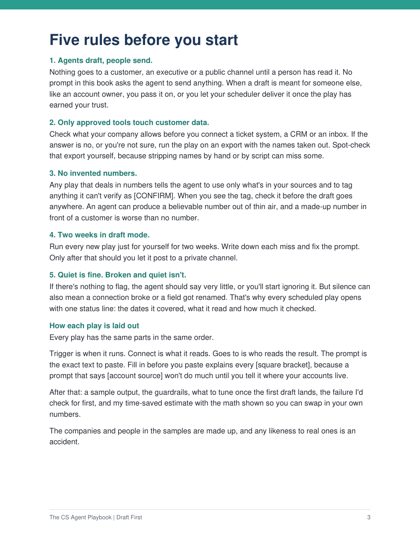
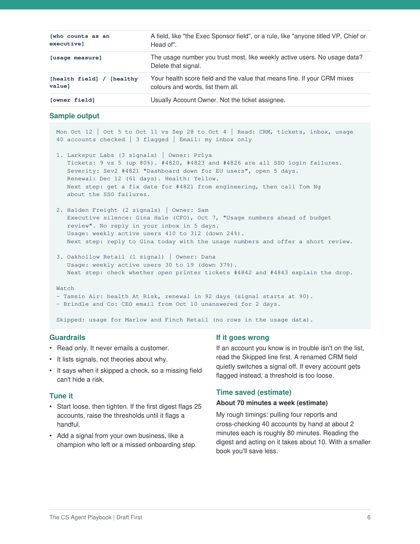
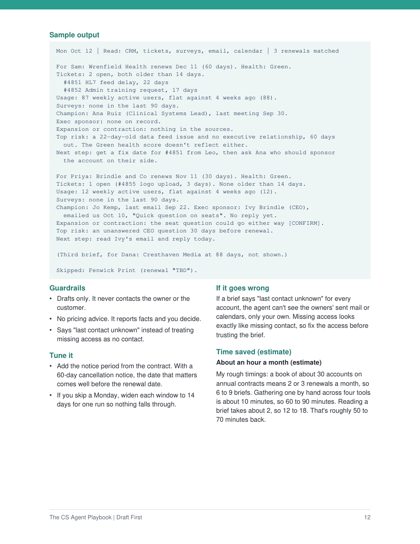
35 pages. Every play gets two pages:
- when it runs and which tools it reads
- the exact prompt to paste
- a fill-in list that explains every [bracket], so the prompt matches your own field names
- guardrails, so it never does what you don't want
- a full sample of a good result (with made-up companies)
- how to tune it after the first draft
- the failure to check for first
- a time-saved estimate with the math shown
Around the plays you also get a one-page setup guide with a block of standing rules to paste into your agent, five safety rules, a 14-day rollout plan, a blank template for writing your own play, and a time tracker so you can swap my estimates for your numbers. A plain-text file of all 14 prompts comes with it, so you aren't copying out of a PDF.
A taste: the Monday Churn-Risk Digest
This is what the output looks like. The companies are made up.
Oct 5 to Oct 11 vs Sep 28 to Oct 4 | Read: CRM, tickets, inbox, usage
40 accounts checked | 3 flagged

1. Larkspur Labs (3 signals) | Owner: Priya
   Tickets: 9 vs 5 (up 80%). #4820, #4823 and #4826 are all SSO login failures.
   Severity: Sev2 #4821 "Dashboard down for EU users", open 5 days.
   Renewal: Dec 12 (61 days). Health: Yellow.
   Next step: get a fix date for #4821 from engineering, then call Tom Ng
   about the SSO failures.

2. Halden Freight (2 signals) | Owner: Sam
   Executive silence: Gina Hale (CFO), Oct 7, "Usage numbers ahead of budget
   review". No reply in 5 days.
   Usage: weekly active users 410 to 312 (down 24%).
   Next step: reply to Gina today with the usage numbers and offer a short review.

...

Skipped: usage for Marlow and Finch Retail (no rows in the usage data).
That first line and the Skipped line matter. Every scheduled play tells you what it read and what it couldn't check, so a broken connection or a renamed field doesn't look like a quiet week.
Want to go deeper first? Read the free guides for customer success leads or try the free churn risk calculator.
The free sample is the Escalation Brief, complete with prompt, guardrails and sample output, so you can judge the rest by how that one reads.
About the time claims
Every time estimate in the book is labelled as an estimate, with the math next to it. For the digest above: checking 40 accounts by hand at about 2 minutes each is roughly 80 minutes, and reading the digest takes about 10. That's about 70 minutes back a week. Those are my own rough timings, not a study, and your team will differ. That's why the last page is a tracker for your real numbers.
Be ready for the first week to cost you time. I'd plan on 30 to 60 minutes of setup and tuning per play (my estimate). The savings come after that.
Couldn't I just ask an AI to write these?
You could, and for some of them you'd land somewhere decent. The prompt text is the easy half. What you're paying for is the set of choices around it: which signals to check and where the thresholds sit, fixed date windows that work even though agents don't remember last week, what a good result looks like, what to look at when it quietly goes wrong, and an order to roll it all out in. It's a shortcut past your first few rounds of trial and error.
Built to be safe
Agents draft, people send
Nothing goes to a customer, an executive or a public channel until you've read it.
No invented numbers
The agent uses numbers from your sources only. Anything it can't verify gets a [CONFIRM] tag.
Two weeks in draft mode
Every play runs just for you first, while you fix the prompt.
Your tools, your rules
It works with ChatGPT, Claude, Gemini, Copilot or whatever agent your company approves.
Who made it
Draft First was started by someone with more than 20 years in technical support and customer success, first working the queue and later leading teams. These are the routines we wish we'd had on day one, written down so you can skip the trial and error. More about us.
$39 for the 35-page PDF, plus the plain-text prompts file. Launch code FIRST50 takes $10 off for the first 50 buyers.
Not sure yet? Read the free sample play first, so you know exactly what you're getting.
Free resources for customer success leads
Not ready to buy? These free pages are the most useful place to start.
Questions
- Do I need to code?
- No. You paste a prompt, connect the tools you already use and pick a schedule.
- Which agent do I need?
- Any agent that can read your tools. If yours can't run on a schedule, set a recurring reminder and paste the prompt yourself. You lose the automatic part and keep the rest.
- Is my customer data safe?
- Only connect tools your company approves. If you're not sure, run a play on an export with the names taken out, and check that export yourself first.
- I'm in support, not customer success. Is it still useful?
- Most of it, yes. The escalation brief, inbox triage, knowledge base gaps, workload check, survey follow-up and 1:1 prep don't depend on a CS title. The renewal, QBR and handoff plays are aimed at account management.